A Nigerian shop owner stands in the open doorway of her clothing boutique at golden hour, holding up her phone with Rexeipt's Owner's Office open. The shop interior glows warmly behind her.

The Rexeipt Journey · A sales mission

Where you started.
Where you are right now.
Where we are going.

Rexeipt is the co-owner that runs the boring half of the business so the human half can run the rest. Not software you ask for an answer. A partner that asks first, listens, proposes, and waits for you to decide. This page is the journey we walk with every business that joins us — and the mission every person on the sales team is asked to carry.

OrderInsightDecisionsConnectionLoyaltyTrust

The day-one letter · the contract

The first thing every business owner reads.

Rexeipt does not begin with a feature. It begins with a letter. On day one, after enough sales and enough receipts have flowed through the system to have a record worth looking at, the merchant opens their Owner's Office for the first time and finds this on the screen. It is not marketing copy. It is a contract.

Welcome to your office.

You have been on Rexeipt for a while now. Every sale, every receipt, every restock, every customer note has been quietly building into something — a record of what your business is, and a quiet hint at what it could become. Until today, that record sat behind the dashboard. From today, we have laid it on the table.

This room — your Owner's Office — is where we sit together once in the morning, once on Friday, once at the end of the month, and once at the end of the quarter. We look at what happened, we ask what should happen next, we agree, and you decide. I propose; you decide. That is the rule.

You will see a Journey Board across the top of this room. The far-left card shows where you started. The middle card is where you are right now. The far-right card is where we are going — three years out, drawn the way a child draws a future they want, because that is how human beings remember to fight for something.

If you ever stop coming, I will not nag. I will reach out gently the first time, more quietly the second, and only ask “are you OK?” on the third. If you need to step away, the room will still be here when you come back.

I will remember the things you say so you do not have to. If we agree to do something on Tuesday, I will ask on Tuesday. If a goal starts slipping, I will not wait for the quarterly review to mention it. Nothing you commit to will fall off the table silently.

— Rexe

That letter is the entire sales pitch in one paragraph. If a prospect is moved by it, they are the right business for us. If they aren't, no feature list will change their mind. Every section below is just an unfolding of the promises in that letter.

The journey · six chapters

The growth journey, told
the way it actually happens.

Rexeipt does not promise overnight transformation. It promises a sequence — six movements that unfold in a specific order because no business has ever skipped them and stayed standing. Order comes first because the chaos has to settle before the patterns can speak. Insight comes before decisions because nobody decides well in the dark. Connection comes after decisions because you have to know your own house before you can welcome the neighbours. Loyalty comes after connection. Trust comes last — because trust is what the other five make.

Two hands across a wooden shop counter — a cashier offering a printed receipt, a customer receiving it, with folded Naira notes resting on the counter between them in warm shop light.

I

Chapter one

Order.

Before anything else, the chaos has to settle.

Most of the businesses we meet are running on memory. Receipts in a drawer. Numbers in a head. Customers in a phone. The first thing Rexeipt does is the smallest, most under-credited thing in software: it makes every sale, every restock, every cash drop, every IOU, fall into the same place — calmly, without paperwork, without ceremony. The first month is not exciting. It is a quiet sigh of relief.

  • Every receipt becomes a verifiable record, instantly, offline-first.
  • No double-entry. No second app. The till is the ledger.
  • When the day ends, the day is closed — and the closing is automatic.
A small wooden desk in early morning light: a tablet showing a clean revenue chart with three text insights below, a steaming porcelain cup of tea, a leather-bound notebook with handwritten notes, and an open ledger to the side.

II

Chapter two

Insight.

Once the records are quiet, the patterns start to speak.

A clean ledger is not the goal. The goal is what a clean ledger lets you finally see. Within a few weeks, the owner walks into her morning and finds the numbers already studied. Which products are pulling weight. Which days are quietly losing money. Which customers come back. Which suppliers show up late. The Strategist does the reading; the owner does the deciding. For most owners, this is the first time their own business has spoken back to them.

  • Trends, anomalies, and seasonality surfaced before the owner has to ask.
  • Plain-language insights — never charts without a story.
  • Per-store, per-product, per-channel — already reconciled.
A Nigerian husband-and-wife small-business team at a wooden kitchen table in warm evening light, leaning together over a single phone screen mid-decision, two cups of tea on the table beside them.

III

Chapter three

Better decisions.

Insight is not a decision. We close that gap.

Knowing your top product is up 18% is interesting; deciding to call your supplier today and pre-order before the price moves is a decision. Rexeipt is built for the second move. Each insight comes paired with a proposal — a draft message, a draft order, a draft routine, a draft milestone — that the owner edits or accepts in one tap. Nothing happens to the business without the owner saying yes. But everything that should happen, gets proposed. We move from data → opinion → decision in the same breath.

  • Strategist proposes; the owner decides — every time, without exception.
  • Decisions are remembered, followed up on, and brought back if they slip.
  • Multi-year goals translate into Tuesday-morning tasks automatically.
A Nigerian tailor in his market workshop hands a folded length of bright Ankara fabric across his shop threshold to a Nigerian woman restaurant owner who has come to collect it — both mid-conversation in afternoon market light.

IV

Chapter four

Connection.

No business grows in a vacuum. We name the network the owner already has.

Behind every small business is a quiet web of others — suppliers, peers, customers who recommend, businesses that buy in bulk, partners who refer. That web has always been invisible, untracked, and fragile. The moment a second business on Rexeipt sells to one already on Rexeipt, the connection becomes a real thing — a verified edge in the Trading Graph. Re-orders take seconds. Late suppliers become visible. Peer benchmarks (opt-in, anonymous) tell an owner whether her margin is normal for her category, in her city, this season. The network stops being a rumour.

  • The opt-in Rexeipt Directory turns local commerce into a discoverable layer.
  • Trading Graph: suppliers, customers, peers, partners as first-class edges.
  • Anonymous peer benchmarks — "are my margins normal?" answered honestly.
A returning customer at the door of a small upscale Nigerian salon mid-laugh as the stylist greets her by name, walking toward her with arms slightly open in genuine warmth.

V

Chapter five

Loyalty.

Customers come back when they are remembered the way a friend would remember them.

Most loyalty programs are insulting in their thinness. A points card. A discount code. Rexeipt builds the other kind of loyalty — the kind small businesses have always had but never been able to scale: the stylist who remembers the wedding, the restaurant that remembers the allergy, the boutique that knows what your sister wears. We hold the small notes the owner used to keep in her head, and put them back in front of her at the moment they matter. We never market to the customer in the owner's name. We help the owner be remembered, and remembered well.

  • Customer notes stay private to the business — never marketing fodder.
  • Returning customers are surfaced by name at the moment of contact.
  • Repeat-rate, recency, and lifetime are everyday numbers, not analytics.
A close-up of a customer's smartphone showing a verified digital receipt with a green checkmark, with two hands shaking across a wooden shop counter softly out of focus behind it.

VI

Chapter six

Trust.

When every actor in the room can verify what the others did, the room itself becomes safer to grow in.

The deepest thing Rexeipt builds is not a dashboard or a directory. It is verifiability. A customer can confirm that the receipt is real. A supplier can confirm that the order is real. A partner can confirm that the referral is real. Tax authorities can confirm that the records are real, the way they are. When trust is the substrate, transactions become faster, terms get better, fraud thins out, disputes shrink. The whole ecosystem — owners, customers, suppliers, government — moves a little more honestly because nobody has to take anyone's word for it.

  • Verified receipts every customer can check — and a tamper-evident audit trail.
  • Compliance is a by-product of operating cleanly, not a separate exercise.
  • Disputes shrink. Terms improve. The cost of doing business quietly drops.

The room

This is what
Monday morning
looks like.

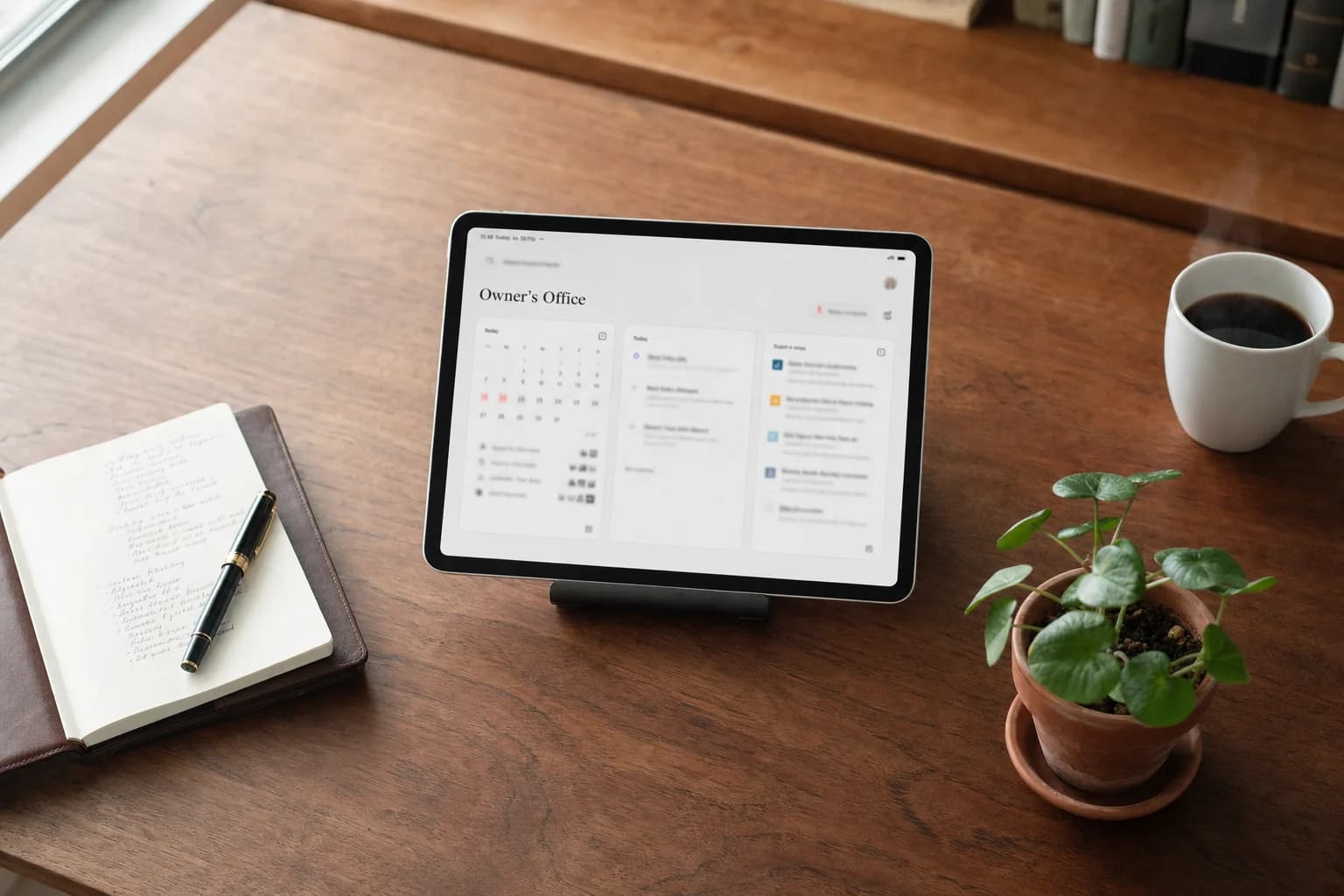
Every business that joins Rexeipt is given a single physical place to return to: the Owner's Office. At the top of the room sits the Journey Board — three cards, left to right: where you started, where you are, where we are going. Below it, a Today panel surfaces the three things that actually matter today, separated from the eighty that don't. Beside it, an Open Loops register holds every promise you made to yourself, every decision waiting for a follow-through, every routine the system is keeping warm on your behalf.

A salesperson should be able to describe this room from memory. A Monday morning, a cup of coffee, and a calm, dignified surface that already knows what the day is asking of you. That is the product.

  • Journey Board — three frames of the same business, rendered the way a child draws the future they want.
  • Today panel — three priorities, ranked, each with the reason it earned the ranking.
  • Open Loops — every commitment in flight, none of which the system will let fall off the table silently.
  • Cadence — daily open, Friday review, end-of-month, end-of-quarter, all scheduled, all warm.
A clean wooden desk in soft morning light: a tablet on a stand displaying the Owner's Office interface with a calendar, a today panel and an open-loops list, beside a leather notebook with a fountain pen, a small terra-cotta plant, and a porcelain cup of coffee.

The senior team

Eight named seats.
One quiet senior team.

We do not call them agents. We call them what they are. A senior team, eight roles strong, that a single-store owner could not otherwise afford to hire — and even the businesses that could afford them rarely manage to keep that many people in calm agreement with each other. Each role has a name, a brief, and a written remit. The owner sees them not as software but as the people working on the boring half of the business so the human half can run the rest.

A thoughtful Nigerian senior advisor in her late 50s in a cream blouse and gold-rim glasses sits at a dark-wood desk reviewing notes in a leather portfolio, library shelves softly behind her.

The Strategist

The chief of staff. Holds the goals, runs the reviews, brings drift back to the table before it becomes a crisis.

Example
Notices a quarter-end goal slipping in week six, proposes the two changes most likely to recover it.

A close-up of a Nigerian bookkeeper's hands writing neat columns of figures in an open hardback ledger book with a fountain pen, a small printed receipt and a calculator visible at the edge of the desk.

The Bookkeeper

Closes the books quietly. Reconciles cash to the till, the till to the bank, the bank to the books — every day.

Example
Flags that ₦42,000 from yesterday's till never reached the bank, drafts the question for the cashier.

A Nigerian woman at a small wooden desk wears a thin headset mid-call, her expression empathetic and patient, a notebook with names and amounts open in front of her.

The Collections Clerk

Tracks every IOU and outstanding invoice. Asks for what is owed in the owner's voice, never aggressively.

Example
Sends the third polite reminder to a late customer, escalates only when the owner approves.

A Nigerian man in his mid-30s in a dusty-blue shirt and work apron stands in a clean stockroom holding a clipboard and a pencil, calmly counting boxes on a shelf.

The Inventory Steward

Watches the stockroom. Notices fast movers, slow movers, and the items that are about to run out before the customer does.

Example
Drafts a re-order list at the end of every week, ranked by the items that are about to disappoint a customer.

A Nigerian woman in her early 30s in a navy blazer and gold-rim glasses studies a complex financial chart on her laptop, chin resting on her hand in focused thought.

The Analyst

Reads the numbers and tells the owner what they mean — in plain language, with a story and a recommendation.

Example
Notices that Tuesdays are quietly losing money for three months, proposes a different staffing schedule.

A Nigerian woman in her late 30s in a camel blazer leans against a wooden wall inside a small shop, observing a counter interaction in the soft-focus background, an open notebook with a pen in her hand.

The Sales Coach

Studies the conversion behaviour at the till and on the storefront. Surfaces what is working, what is leaking.

Example
Notices that customers are abandoning carts at delivery, proposes a small change to the storefront copy.

A senior Nigerian cashier supervisor in her late 40s leans gently over the shoulder of a younger cashier at a POS terminal, pointing at the receipt printer with a kind, patient teaching expression.

The Cashier Supervisor

Makes the till mistake-proof. Catches missing receipts, double charges, and discounts that look out of pattern.

Example
Holds back a receipt that has a 35% discount on a brand-new SKU and asks the cashier to confirm.

A Nigerian man in his early 50s in a crisp white shirt sits at a wood-panelled office desk, reviewing a printed financial document with a slim fountain pen, a tidy stack of manila folders to his right and a brass desk lamp casting warm light.

The Tax & Compliance Clerk

Keeps the records the regulator wants in the shape they want. The end of the tax year stops being an event.

Example
Maintains the trial balance live, prepares the FIRS-ready submission a week before it is due.

The Cabinet does not act unilaterally. Every meaningful proposal travels through the Strategist, who brings it to the owner with a recommendation. The owner decides. The decisions are remembered. The follow-throughs are scheduled. Nothing falls off the table.

By industry · day one → year two

Six businesses,
six journeys.

The journey is the same. The shape of it inside any one business is not. Below are the six categories where Rexeipt is already walking businesses through this arc — what changes between day one and year two, in plain language, in their own setting. Salespeople: pick the one closest to your prospect's shape and start the conversation there.

A Nigerian fabric stall owner in a deep-blue head wrap stands among floor-to-ceiling stacks of brightly patterned Ankara and Adire fabric in a covered Lagos market, holding her phone mid-WhatsApp message.

Fashion

Abeokuta fabric stall · Lagos boutique · Ankara wholesaler

Day one

Bolts of fabric counted by hand, customers tracked in WhatsApp threads, Sallah-season margin lost to disorganised re-orders.

Year two

Inventory by SKU and colour, three repeat-customer cohorts known by name, Trading Graph edges to two tailors and four boutiques, margin recovered before the next festival.

A Lagos restaurant kitchen during the calm minute before service: the owner-chef in whites stands at a stainless-steel pass reviewing the day's prep on a tablet, two chefs working at stations behind her.

Food & restaurants

Lagos restaurant · Abuja catering · Port Harcourt kitchen

Day one

Prep lists in the chef's head, food cost a vague feeling, Mondays quietly losing money for reasons no one has time to investigate.

Year two

Daily prep auto-generated from the previous week's pattern, food cost reconciled per dish, Monday's staffing rebuilt, two profitable new dishes invented from leftover-pattern data.

A clean modern Abuja salon: the owner stands at the front reception desk reviewing the day's appointments on a tablet, two stylists working with clients in soft focus behind her.

Beauty & wellness

Abuja salon · Ibadan spa · Lagos barber chain

Day one

Bookings on a paper diary, no-shows accepted as a fact of life, repeat customers blurred into the daily blur of new ones.

Year two

Bookings tied to known customers, no-show rate cut by visible reminders, six stylists running their own micro-books inside the room, the owner finally home by 7pm.

A clean small community pharmacy: a pharmacist in a white coat stands behind a glass counter, one hand on a tablet showing stock and expiry data, the other gently offering a small white bag to a customer.

Pharmacy & retail health

Port Harcourt pharmacy · Abuja diagnostic centre · Lagos health-and-beauty

Day one

Stock counted weekly at best, expiry tracked when remembered, regulatory paperwork a separate weekend headache.

Year two

Live stock and expiry, regulator-ready reports continuously prepared, customer notes that catch repeat prescriptions, a quiet lift in margin from never running out of the right SKU.

A Nigerian professional services consultant at a small wood-paneled Lagos office, sitting at a desk wearing a thin headset, reviewing an invoice draft on her laptop, a brass desk lamp and a single white orchid beside her.

Professional services

Lagos legal practice · Abuja consultancy · Lagos creative studio

Day one

Invoices late because nobody enjoys writing them, retainers slipping, follow-ups remembered the week after the right week.

Year two

Invoices drafted automatically from completed work, follow-up scheduled and warm, three retainer clients who came back because the system never let the relationship cool.

A Nigerian neighbourhood retail shop: the owner stands behind a counter stacked with packaged goods and household items, reviewing today's sales on her phone while a customer waits at the till.

Retail business

Lagos mini-mart · Kano provision store · neighbourhood shop

Day one

Prices checked from memory, fast movers restocked when the shelf looks empty, end-of-day cash rarely matching what sold.

Year two

Every SKU tracked, reorder list built from real sales velocity, weekend peaks visible before they arrive, margin honest on the top twenty items.

These are not testimonials. They are the recurring pattern of what we see when a business stays inside the system long enough for the journey to compound. Day one is the floor; year two is not the ceiling. It is just the place where the room starts to feel like a room.

The Compact · seven loops

Nothing falls off the table.

The deepest promise Rexeipt makes is the one most software quietly fails at: continuity. Goals slip. Routines lapse. Tasks stall. Decisions get forgotten. Reviews get missed. Owners disappear for two weeks and feel guilty about it. Most systems respond with reminders that grow louder, then nag, then go silent. We respond with seven specific loops, each designed to keep a commitment warm without ever shaming the person who made it. This is the Compact. It runs in the background of every other surface. Without it, the Owner's Office is just a dashboard.

Goal drift

When a multi-year goal starts slipping mid-quarter, we surface it that month — not at the quarterly review.

Routine roll-forward

When a routine task is missed, the system rolls it forward and asks — not blames. Discipline without shame.

Task stall triage

When a task sits idle for too long, the Strategist asks if it should be re-scoped, re-assigned, or quietly dropped.

Decision follow-through

When the owner agrees to do something on Tuesday, we ask on Tuesday. We do not forget. We do not accumulate.

Review-missed recovery

When a Friday or month-end review is missed, the next prompt is gentler — not louder. The room waits, kindly.

Owner-absent kindness ladder

If the owner stops showing up, we reach out gently the first time, more quietly the second, and only ask "are you OK?" the third time. We do not nag.

Open Loops register

Every promise the owner has made — to themselves, to a customer, to a supplier, to the team — sits in one register. The Strategist reads it before every conversation.

Every loop is a backstop against a specific way that commitments die in small businesses. None of them is dramatic. All of them are why Rexeipt feels, after six months, like a partner instead of a tool.

The compounding moat

Every month a business stays
makes the next month easier.

Memory compounds

The longer a business is on Rexeipt, the more the system knows about it — which products move, which suppliers run late, which customers come back, which routines actually keep the team honest. A new vendor showing up on month thirteen does not have that memory. They cannot rebuild it from a CSV.

Network compounds

The longer a business is on Rexeipt, the more of its trading partners are also on Rexeipt. Re-orders get faster. Disputes get rarer. Peer benchmarks get sharper. The Trading Graph underneath grows quietly until leaving the room means leaving the network the business has been growing inside.

Habits compound

The longer a business is on Rexeipt, the more its weekly, monthly, and quarterly rituals are running on Rexeipt's cadence. The Friday review. The month-end close. The quarterly planning conversation. By month eighteen, those are not features the owner uses. They are how the owner runs.

Switching costs in software usually mean an export and a few hours of pain. Switching costs here mean walking away from a memory of your own business that you spent two years building, a network of partners you found inside the room, and a cadence that has become the way Monday morning feels. We are not afraid to say it: that is the moat, and it is built on the merchant's side, in the merchant's favour.

What we will refuse to be

Five red lines
we will not cross.

Every product makes promises it intends to keep. The interesting thing is the promises a product makes about what it will refuse to do, even at the cost of growth. These are ours. They are not feature ideas. They are the integrity of the room. If a competitor offers the same surface area but breaks any of these, they are offering a different product.

RED LINE

We will not auto-fire on adherence.

A merchant who misses a routine is a human, not a metric. We follow up gently. We never escalate to humiliation. The kindness ladder is a hard rule, not a soft suggestion.

RED LINE

We will not write marketing copy at re-engagement.

When a merchant goes quiet for weeks, the message they get back is not "we miss you 💚 here's 20% off!" It is a short, plain, human "are you OK?" — and only after the second silent month. Anything else degrades the contract.

RED LINE

We will not make Journey Boards public.

A merchant's three-year picture is private. We will never expose it on a directory, share it with peers, sell it to investors, or surface it to advertisers. The room is sealed. Always.

RED LINE

We will not use surveillance language.

No "we noticed you didn't open the app today." No "your team's adherence is 64%." No tracking, scoring, or shaming language anywhere in the product. The system observes only what is needed to be helpful, and the words we use reflect that.

RED LINE

We will not use the customer's data to market to them.

Customer notes belong to the business. We hold them so the owner can be a better friend to her customer — not so we can run ads, send promotions, or hand them to a third-party platform. The customer record is sacred.

A note for the sales team

What we are asking you
to carry into the room.

The mission, in one breath

We are not here to sell software to businesses that want a tool. We are here to find businesses that are willing to grow, and to walk a multi-year journey with them — the journey from order to insight to better decisions to connection to loyalty to trust. Every conversation you have should be testing for that willingness. The right prospects are the ones who lean in when they hear the day-one letter. The wrong prospects walk away from a contract; they will walk away from this one too.

The four C’s · one line each

C · Compass

Where this business is going.

C · Cadence

How the team keeps moving.

C · Community

Who they are doing business with.

C · Compact

What we promise will not fall off the table.

Three things to say

  • "Rexeipt is the co-owner that runs the boring half of your business so you can run the rest."
  • "It walks every business through the same six chapters: order, insight, decisions, connection, loyalty, trust."
  • "It will never let a goal, a routine, a task, or a decision fall off the table silently."

Three things never to say

  • "It's an AI tool." — It is a senior team. Use the names.
  • "It will replace your accountant." — It will hold the books cleanly so the accountant's job becomes oversight, not data entry.
  • "It's free for the first month." — Rexeipt does not lead with discounts. The contract is the contract from day one.

Read the day-one letter aloud, slowly, at least once. When a prospect can finish the sentences before you do, you have found a business worth walking with.